
Photo Credit: Robert Hoatson
By Elise Phillips Margulis
Published May 26, 2025
WEST ORANGE, NJ — Dr. Robert Hoatson, an on-and-off resident of West Orange for 32 years, grew up in Tory Corner and the Merklin tract. He’s been living in the Renna House for over 11 years and was recently appointed to the Board of the Renna House.
Hoatson, a brave activist, shared that he was sexually abused by a priest and custodian in West Orange at St. Joseph’s Church and at his home by a religious superior of his – as well as other locations in New Jersey and New York State.
He shared, “I was an Irish Christian Brother for 23 years and a priest for 14 years. I lived in the rectory of Our Lady of Lourdes in West Orange (Eagle Rock Avenue) from approximately 2001 to 2003. I was told to move out by the Archbishop of Newark when I complained that a pedophile priest had been moved in by the pastor.” He continued, “I contacted the town council in 2003 about the presence of a pedophile priest in a West Orange parish that had an elementary school on its grounds, but I was ignored.”
Hoatson worked with victims of a Police Athletic League (PAL) worker who abused children in the PAL clubhouse. Hoatson noted, “At least one of those victims committed suicide, and his father lives in the Renna House. It was tragic!”
Hoatson founded a non-profit charity based in West Orange in 2002 called Road to Recovery to assist victims of sexual abuse (primarily clergy abuse) and their families, and he wanted to expose the corruption and cover-up of the abuse as a Church insider of approximately 40 years.
Road to Recovery, Inc. has assisted 5000+ victims and families since 2002 and continues to do so. Hoatson shared, “My co-founder, Msgr. Kenneth Lasch, lives in Pompton Plains, and went through similar treatment as I.”
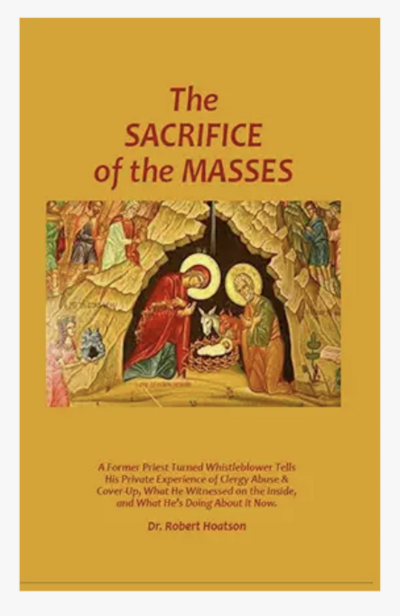
Hoatson, as a former priest, is an insider tackling a heartbreaking topic. In Sacrifice of the Masses, he weaves his experiences with those of the survivors he met at Road to Recovery. The raw accounts and the people who Road to Recovery couldn’t help in time, make for a difficult but important read.
Victims are violated by the clergy members and then silenced by the church. Hoatson described people whose lives were devastated and how his organization helps them heal. The book shows his commitment to survivors and illustrates that receiving support helps them to continue with their lives.
In The Sacrifice of the Masses, Hoatson is able to describe the church hierarchy because he was a priest. He speaks of courageous survivors and stresses that there’s more work to be done to eliminate the betrayal of spiritual leaders. The book is full of horror but also contains hope for recovery. Hoatson has dedicated his life to assisting them. He also calls for transparency, accountability and support from the Catholic Church.
The book is available on Amazon.
The Sacrifice of the Masses
Dr. Robert Hoatson, PhD
Diamond Publishing
254 pages
Review by Msgr. Kenneth E. Lasch, JCD
The Sacrifices of the Masses is a riveting description of one man’s painful journey of recovery from sexual abuse by clergy and religious. More than that, it is the story of a victim turned survivor, whistleblower, advocate and healer of souls. Sexual abuse by clergy imposes a life sentence. It is the murder of innocent souls, there are no quick fixes or cures but there is a road to recovery that former priest and author, Dr. Robert Hoatson, has paved for numerous victims. Over the course of more than twenty-five years, through ‘Road to Recovery, Inc.’ Bob Hoatson, founder, has touched the lives of over 5,000 victims and their families. His confrontation with bishops and other church officials was costly and led to his eventual return to the lay state. This book of 253 pages tells it all like it was and is as he sees it whether you like it or not. It’s a tough read. It’s a gutsy book. Bob writes as he speaks in the streets. It triggered for me memories of my own recovery as a vicarious victim of clergy abuse. Yes, victims’ advocates are susceptible to the effects of sexual abuse due not only to their outreach to victims but due more so to their confrontation with those in authority who have covered up abuse, bishops in particular, most of whom have yet to be held accountable. Advocates are subject to moral trauma and the symptoms of PTSD.
Underscored as what might be called a subplot is Dr. Hoatson’s description of the clericalism that permeates religious life and rectory life. His experience as a former brother and priest has enabled him to offer ample testimony to the dysfunctional lifestyle that has characterized clerical life in the Catholic Church.
The author’s anger at the Church remains unabated. Some readers, still practicing Catholics, including those who are dismayed by the scandal of abuse and more so by the coverup by bishops, may find this disconcerting and unfair. The Roman Catholic Church is indeed more than an institution and not every disaffected victim has left the Church but the scandal will not end until the whole story is told.
Victims of clergy abuse will need to read this story with caution. It may trigger some hurtful memories.
Kenneth E. Lasch, JCD
Co-Founder, Road to Recovery, Inc.